

Highlights of Annual Review of Root Cause Analysis Cases at Valley Medical Center
At Valley, safety is our core value. We put a lot of focused attention on preventing harm to patients by ensuring our systems and processes are reliable, safe, and make it easier to do the right thing while also making it harder to make a mistake that could lead to patient harm.
When an unanticipated outcome happens, or a human error causes potential harm to patients, the patient safety team partners with operational and clinical leaders to learn how the error happened. They create a plan to improve systems and processes in a way that will prevent it from happening again. These cases are referred to as Root Cause Analysis (RCA).
Here are some highlights from the annual review of RCA:
- Valley saw a 72% reduction in Serious Safety Events compared to the last fiscal year.
- 80% of RCA cases involved Procedural or Care Management events. These include wrong procedure, issues in technique and procurement of specimens, delays in diagnosis or treatment, and medication errors.
- 70% of the human errors that contributed to patient harm were skill-based errors: routine acts performed in familiar environments using learned skills. Also known as “auto-pilot mode”.
- 55% of the system causes of preventable harm are related to the design of work processes. This includes processes with inadequate checks, inadequate interfaces, or poorly sequenced or omitted actions.
What our Root Cause Analysis tells us about the system causes of preventable harm:
We know that human error is inevitable. Everyone makes errors, even experienced, professional people. We work in high-risk situations that increase the chance we will make an error. Most near-misses and significant events are due to system or process problems. When we develop actions to prevent errors from recurring, we ALWAYS focus on the system failures for our improvement work. It is important to understand how the individual human error happened, to know what the system failure was.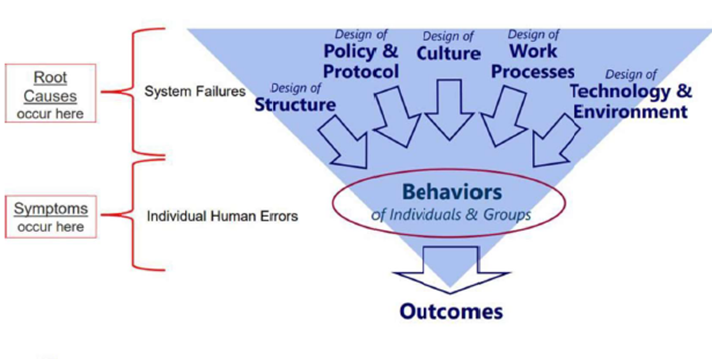 Behaviors that decrease human error:
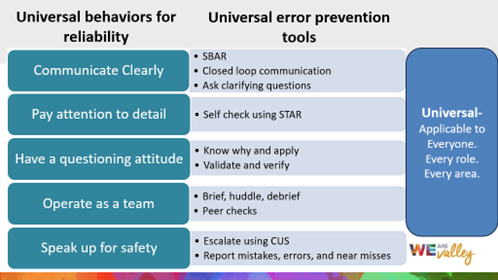
We can avoid most errors by practicing low-risk behaviors, or universal behaviors for reliability. Practicing these behaviors consistently allows us to find and fix problems, and more reliably prevent errors from happening.
Progress in Safety and Reliability in the last fiscal year:
- All new employees attend TeamSTEPPS training as part of orientation.
- All new employees attend introduction to High Reliability and an overview of human error and universal reliability skills as part of orientation.
- Physician leaders in all departments are engaged in safety event review.
- New monthly standing new leader orientation to High Reliability, the leader’s role in managing safety events, and Daily Safety Brief reporting (DSB).