Vascular Surgery New Advancements at VMC
Fenestrated Endovascular Aneurysm Repair for Abdominal Aortic Aneurysms
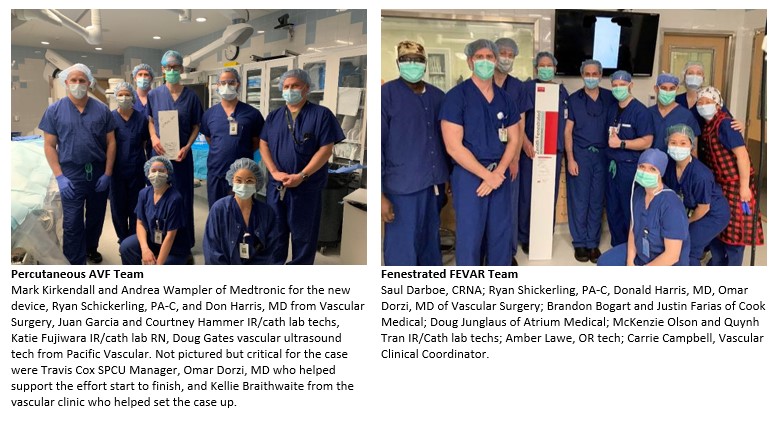
Valley Medical Center had its first fenestrated endovascular aneurysm repair (FEVAR) case performed this week, with a team led by Omar Dorzi, MD, vascular surgeon and medical director. Valley is now the only hospital in South King County with this advanced procedure for abdominal aortic aneurysms (AAA).
This minimally invasive procedure involves stenting for a complex AAA that is adjacent to the kidney arteries. FEVAR requires a graft that is made specific to the patient's anatomy. It’s placed using state-of-the-art imaging in the hybrid operating room where they can combine surgical exposure of the arteries in the groin with advanced imaging. The procedure includes placing stents in the kidney arteries through the aortic graft that is made with fenestrations (holes) to obtain a seal and to avoid leaks around the stent placed inside the abdominal aortic aneurysm.
FEVAR offers an option for patients who may not be candidates for open surgery and treats abdominal aortic aneurysms greater than 5.5 cm in men and 5.0 cm in women, that are adjacent to the kidney and/or bowel arteries. This endovascular procedure also typically offers a shorter procedure time, fewer complications, and a shorter hospital stay compared with open surgery.
Percutaneous Arteriovenous Fistula Creation for Hemodialysis Vascular Access
The first adult percutaneous arteriovenous fistula (AVF) creation within UW Medicine was recently performed at Valley Medical Center, with a team led by Donald Harris, MD, vascular surgeon. This involves creating an arteriovenous fistula for hemodialysis through a single needle puncture in the forearm. Traditionally, fistulas are created through an arm incision; although the surgery is not major, it involves manipulation of the vessels that can predispose to critical stenoses or failure of the fistula, and entails risks of bleeding and infection in the arm.
The percutaneous fistula procedure involves using a radiofrequency probe to create an opening between the radial artery and a vein in the forearm, which eventually matures into the fistula. It is a significant advance because it is very quick, causes minimal vessel trauma, and avoids the risks of an incision in patients who are usually unhealthy and frail. Further, only certain locations in the arm can be used to create a fistula, and the percutaneous procedure uses a site that isn’t normally used surgically, expanding the treatment opportunity for patients with limited options to create a fistula without compromising the ability to create a standard surgical fistula in the future. This is an important new tool for vascular access creation for the ever-expanding community of patients who rely on hemodialysis.